
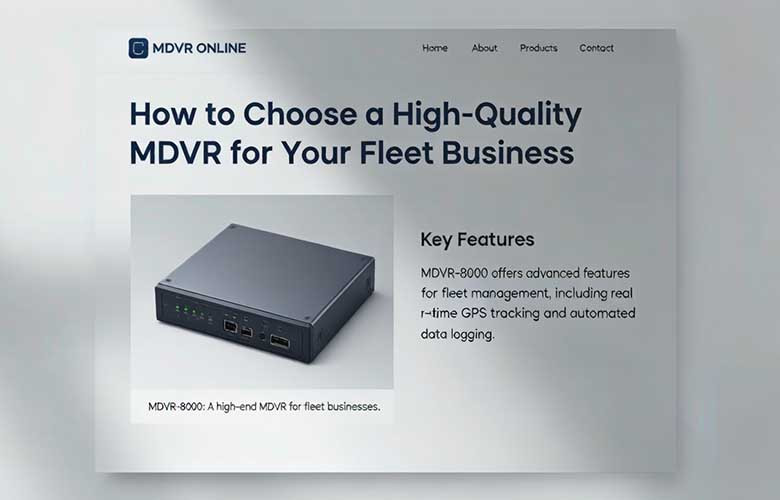
Introduction
Fleet management is all about stability, safety, and traceability. For commercial fleets including trucks, buses, logistics vehicles, and engineering fleets, an ordinary consumer-grade video recorder can never meet long-term operational demands. Many fleet owners face common troubles: device shutdown in high temperatures, blurred night footage, failed video storage, no remote access, or system crashes during bumpy drives. All these problems come from choosing low-quality MDVR devices.
A high-quality MDVR (Mobile Digital Video Recorder) is the core of fleet video surveillance and safety management. It records full driving footage, tracks vehicle routes, provides accident evidence, standardizes driver behavior, and reduces fleet operation risks. This complete guide will walk you through how to choose a high-quality MDVR for your fleet business, covering core specs, essential features, hardware standards, and practical buying tips suitable for commercial fleet scenarios.
What Is a Fleet-Grade MDVR?
Many people confuse regular vehicle MDVR with fleet-grade MDVR. Ordinary MDVRs are usually designed for private cars or light-use vehicles, with low environmental adaptability and simple functions. In contrast, fleet-grade MDVRs are customized for long-hour, high-frequency, and complex road condition operations.
A high-quality fleet MDVR must resist vibration, high and low temperatures, and voltage instability caused by commercial vehicle engines. Meanwhile, it needs to support multi-channel synchronous recording, stable long-term loop storage, and cloud remote management to meet unified fleet monitoring needs. If you run a professional fleet business, choosing dedicated fleet MDVR instead of civilian-grade devices is the first rule to avoid frequent equipment failures.
Key Factors to Choose a High-Quality Fleet MDVR
1. Professional Vehicle-Grade Hardware Adaptability
Commercial vehicles work in extremely complex environments. Trucks and engineering vehicles often run on bumpy roads, while outdoor fleets face extreme temperatures in summer and winter. A qualified fleet MDVR must have excellent shock resistance and wide temperature working range.
High-quality MDVRs adopt industrial-grade shockproof structure and reinforced internal components, which can effectively avoid loose parts and recording interruption caused by long-term vibration. Normally, a reliable fleet MDVR supports a working temperature range of -30℃ to +70℃, ensuring stable operation in cold northern areas and hot southern summers. Besides, it must support vehicle voltage fluctuation adaptation to prevent sudden shutdowns caused by engine startup and shutdown.
2. Reasonable Channel Configuration Matching Fleet Scale
MDVR channel quantity determines the number of connected on-board cameras and monitoring coverage. Small fleets with light trucks or vans can choose 4-channel MDVRs to cover front road, vehicle interior, and rear views. For large fleets such as passenger buses, heavy trucks, and engineering vehicles, 8-channel or even 16-channel high-quality MDVRs are more suitable, realizing full dead-angle-free monitoring.
When selecting channels, do not blindly pursue more channels. Match the channel quantity according to vehicle type and monitoring demands. High-quality fleet MDVRs support multi-channel synchronous real-time recording without frame dropping, ensuring every monitoring angle captures clear and complete footage.
3. Clear Video Resolution & Night Vision Adaptability
Video clarity is the core value of MDVR. Low-quality MDVRs have blurry footage, overexposed daytime images, and completely invisible night scenes, which cannot provide effective evidence after traffic accidents or disputes.
A high-quality fleet MDVR supports 1080P full HD or 4K high-definition recording, with accurate color restoration and strong dynamic light adjustment ability. It can automatically adapt to strong light during the day and low light at night. Cooperated with infrared night vision cameras, it can capture clear license plates, road conditions and driver operations even in dark environments, meeting 24-hour uninterrupted monitoring needs of fleets.
Must-Have Features for Commercial Fleet MDVRs
Different from civilian MDVRs, fleet business requires more functional professionalism and intelligence. When choosing a high-quality MDVR, focus on the following practical core features:
GPS/Beidou Positioning & Track Recording: Synchronously record vehicle driving speed, route, and parking time, helping managers supervise driving trajectories in real time.
4G/5G Remote Transmission: Support remote real-time video preview, video playback, and parameter configuration, realizing off-site unified management of multi-vehicle fleets.
Intelligent Alarm Trigger: Support overspeed alarm, fatigue driving alarm, collision warning and abnormal vibration alarm, actively reminding managers of potential safety hazards.
Loop Recording & Automatic Overwrite: Automatically overwrite old videos to save storage space, ensuring long-term uninterrupted recording without manual cleaning.
Storage Performance: Guarantee for Long-Term Fleet Recording
Fleet vehicles run for a long time every day, so MDVR storage stability is crucial. Inferior MDVRs often have storage card recognition failure, video missing, and file damage problems, leading to no available evidence when accidents occur.
High-quality fleet MDVRs support multiple high-capacity storage cards or hard disks, with anti-loss and anti-corruption file protection technology. When the vehicle suddenly powers off, the device can automatically save the current video file to avoid data loss. It is recommended to choose MDVR devices that support enterprise-level storage cards, which have longer service life and more stable reading and writing performance for long-hour continuous recording.
Common MDVR Buying Mistakes Fleet Owners Make
Many fleet managers only focus on low prices when purchasing MDVRs, which leads to higher later maintenance and replacement costs. The most common mistake is choosing civilian-grade MDVRs for commercial fleets. Such devices lack industrial-grade environmental adaptability and are prone to frequent failures after long-term use.
Another typical mistake is ignoring after-sales service and system compatibility. High-quality fleet MDVRs are matched with professional fleet management cloud platforms, supporting multi-device unified management and data statistics. Devices without platform support will cause difficult video viewing and inconvenient fleet unified supervision, greatly reducing management efficiency.
Final Checklist to Choose High-Quality Fleet MDVR
Before purchasing, check the following standards to quickly screen qualified MDVR products:
1. Adopt industrial-grade vibration and high-low temperature resistance design;
2. Support full HD 1080P+ multi-channel synchronous frame-free recording;
3. Equipped with complete GPS positioning and remote cloud management functions;
4. Stable loop recording and sudden power-off file protection function;
5. Compatible with professional fleet management system with perfect after-sales support.
Conclusion
A high-quality MDVR is not only a video recording device but also an essential safety management tool for fleet businesses. It can effectively reduce fleet safety risks, standardize driver behavior, provide valid evidence for traffic disputes, and improve the overall refined management level of the fleet.
When choosing a fleet MDVR, do not only compare prices. Focus on industrial-grade hardware stability, professional fleet functions, storage safety and platform compatibility. Only by matching high-quality dedicated fleet MDVR equipment can you realize long-term stable and efficient fleet safety management.