
Introduction
Modern public transport and smart city bus management are no longer limited to simple vehicle monitoring. To optimize routes, reduce operational costs, and improve passenger service quality, more fleet operators are adopting Automatic Passenger Counter (APC) systems on buses and coaches. An APC system provides accurate, real-time passenger flow data, helping transport companies make data-driven decisions instead of relying on manual estimation.
If you manage a public transport fleet, bus company, or smart traffic project, understanding how a professional bus passenger counter works will help you upgrade your fleet management system intelligently.
What Is an Automatic Passenger Counter (APC)?
An Automatic Passenger Counter (APC) is an intelligent vision-based device installed at bus doors to automatically record passenger boarding and alighting behavior. Unlike traditional manual counting or simple infrared sensors, modern industrial APC uses binocular stereo vision technology to identify human bodies, movement directions, and crowd density.
The system continuously monitors passenger flow during vehicle operation, saves real-time data, and uploads statistics to a cloud fleet management platform. It records how many passengers get on and off at each stop, calculates real-time passenger load, and generates complete daily, weekly, and monthly passenger flow reports.
How Does a Bus APC System Work?
Professional bus passenger counters rely on dual-lens stereo recognition to capture 3D depth information. The system analyzes object shape, height, and moving trajectory to distinguish real passengers from objects, luggage, or shadows. When a person crosses the monitoring area, the device automatically judges IN or OUT status and updates the passenger volume data in real time.
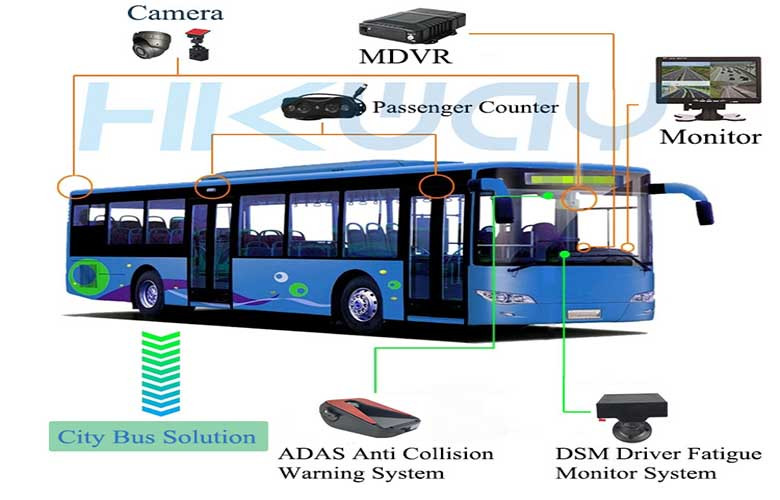
Paired with an onboard MDVR and CMSV6 cloud platform, APC data can be synchronized remotely, allowing fleet managers to view passenger flow statistics anytime and anywhere without on-site checking.
Key Benefits of APC for Public Transport Fleet
- Accurate Passenger Flow Data Statistics
High-precision binocular vision APC achieves over 97% counting accuracy, effectively solving inaccurate counting caused by light changes, crowded passengers, and multi-person simultaneous passing. - Optimize Bus Route and Schedule Arrangement
By analyzing peak passenger flow periods and high-traffic stations, transport companies can adjust bus frequencies, optimize route planning, reduce empty trips, and improve operational efficiency. - Reduce Manual Statistics Cost
Traditional manual counting is time-consuming, labor-intensive, and error-prone. Automatic APC recording realizes 24/7 unattended statistics and standardized data reports. - Support Smart City Public Transport Management
APC passenger data provides reliable big data support for urban traffic scheduling, public transport resource allocation, and smart city project construction. - Perfect Integration with Fleet Monitoring System
Industrial bus passenger counters can be perfectly matched with vehicle MDVR, 4G monitoring cameras, and CMSV6 platform to form a complete smart public transport monitoring solution.
Conclusion
Automatic Passenger Counter (APC) has become essential equipment for modern public transport fleet upgrading. It transforms traditional experience-based management into data-based intelligent management, greatly improving fleet operation efficiency and service quality. For bus companies and smart traffic integrators, deploying high-accuracy binocular vision APC systems is the most cost-effective way to realize digital public transport management.